Crypto Recovery Service vs Law Enforcement Report
Comparing a private crypto recovery service vs a law enforcement report helps victims select the right legal, investigative, and asset-freezing path.

The Executive Verdict: Crypto Recovery Service vs Law Enforcement Report
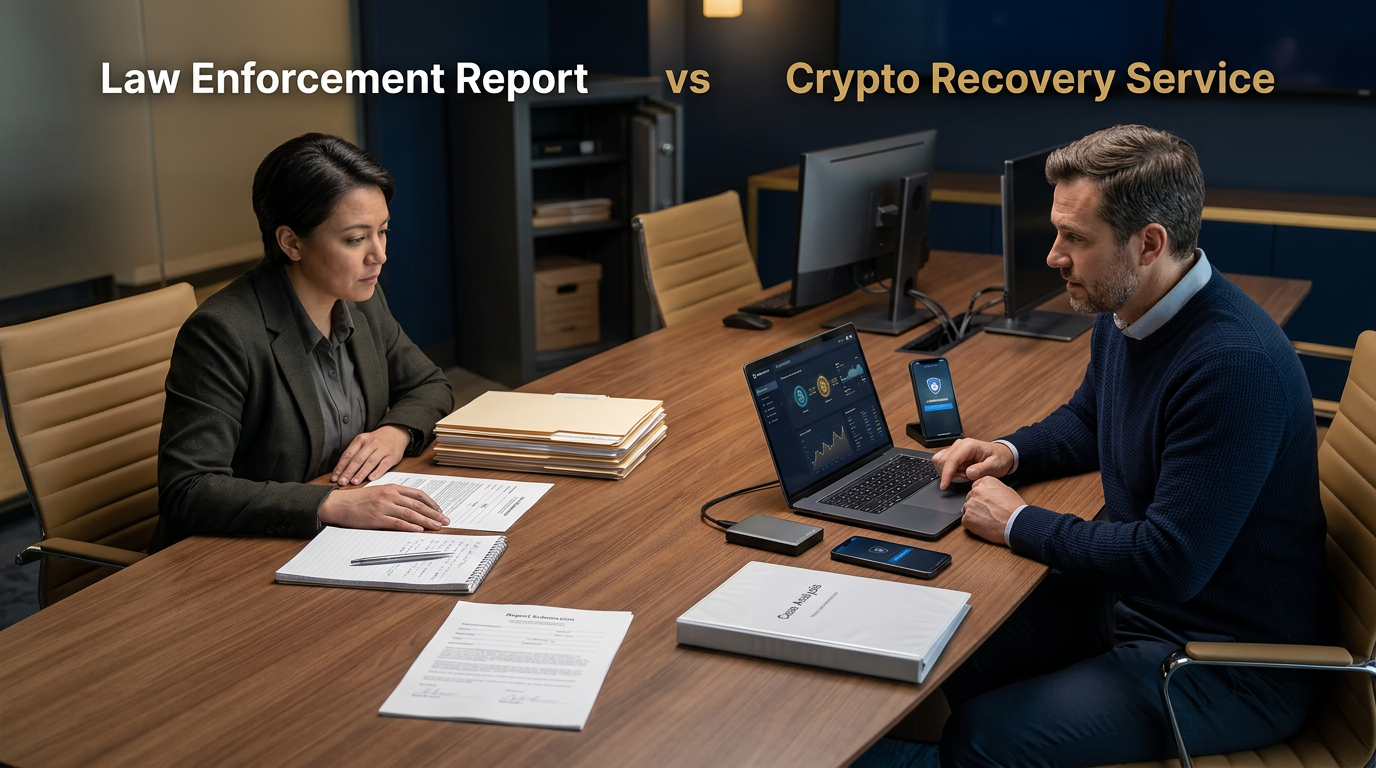
When choosing between a private crypto recovery service vs law enforcement report, victims must understand that these options serve complementary rather than mutually exclusive functions. A police report filed with local authorities or federal databases like the FBI Internet Crime Complaint Center (IC3) establishes an official criminal record, but law enforcement agencies prioritize public safety and systemic threat abatement over individual restitution. Conversely, specialized private blockchain forensics through formal forensic engagement models and civil legal counsel provide dedicated, rapid tracing and evidentiary support tailored to freezing assets on centralized Virtual Asset Service Providers (VASPs). For substantial losses, victims typically require both an official criminal report to satisfy exchange compliance protocols and independent forensic evidence to secure civil injunctive relief through the courts.
Comparing a Crypto Recovery Service vs Law Enforcement Report
Evaluating the operational capabilities, legal limits, and practical outcomes of private investigative firms against government law enforcement bodies is essential for victim strategy. The breakdown below highlights key operational criteria governing asset tracing, subpoena enforcement, and fund recovery potential.
- Investigative Focus & Speed: Law enforcement agencies manage heavy case backlogs and prioritize high-value national security or enterprise-scale syndicates. Private forensic analysts begin tracing immediately upon intake, establishing real-time transaction graphs across mixers, bridges, and cross-chain swaps as detailed in our master cryptocurrency fund tracing guide.
- Subpoena Authority & Legal Seizure: Only law enforcement officers, federal agents, and court-authorized civil litigation attorneys possess the authority to serve binding subpoenas or freeze demands on centralized exchanges. Private recovery services cannot unilaterally seize funds; they produce verifiable evidence for law enforcement or private counsel.
- Evidence Standards & Court Admissibility: Private forensic reports must meet strict evidentiary standards to support ex parte temporary restraining orders (TROs) or civil forfeiture actions under 18 U.S.C. § 981. Reviewing how forensic reports support crypto recovery in court demonstrates why formal chain-of-custody documentation is vital for judicial proceedings.
- Cost Structure & Fee Transparency: Filing an official law enforcement report is entirely free. Legitimate private forensic accounting firms charge transparent fee structures based on hourly or fixed-scope analysis, whereas fraudulent recovery operations routinely demand upfront fees with promises of guaranteed returns.
- Jurisdictional Limitations: Local law enforcement often lacks cross-border jurisdiction or dedicated cybercrime units. Private forensic firms utilize global VASP monitoring tools and collaborate with international legal counsel to track assets across multiple sovereign jurisdictions, including enforcement contexts such as crypto recovery in District of Columbia proceedings and federal court venues.
When Each Option Is the Right Choice
Selecting the appropriate channel depends primarily on the total value of lost assets, the timeline of the theft, and your ultimate legal goals. Neither pathway operates in a vacuum, and understanding when to deploy each resource optimizes your potential for asset preservation.
When a Law Enforcement Report Is Essential
Filing a report with the FBI IC3, Secret Service, or local police department is necessary in almost every financial crime scenario. Major centralized exchanges (such as Coinbase, Binance, or Kraken) frequently require a valid police report number before their internal compliance teams will review informal freeze requests or hold accounts flagged for illicit activity. Furthermore, filing an official report is a prerequisite for insurance claims, tax-loss deductions, and criminal restitution programs if law enforcement initiates a broader seizure operation.
When a Private Forensic Recovery Service Is Necessary
A private forensic investigation becomes essential when the stolen amount warrants dedicated civil litigation, or when law enforcement agencies lack the bandwidth to investigate individual retail losses. Private firms conduct deep-dive blockchain analytics, cluster wallet addresses, identify VASP deposit addresses, and prepare affidavits that meet expert witness court admissibility standards. Private counsel relies on these forensic work products to file emergency John Doe subpoenas and temporary restraining orders before illicit actors can move funds through high-privacy mixers or non-compliant off-ramps. You can examine our forensic investigative process to see how blockchain data is structured for legal escalation.
Common Mistakes Victims Make When Deciding Between Recovery Pathways
Victims of digital asset theft face severe time constraints and immense psychological stress, leading to strategic errors that can permanently impair their ability to trace or freeze funds.
- Mistake 1: Relying Solely on an IC3 Report Without Independent Evidence. Filing an IC3 complaint is important, but federal databases receive hundreds of thousands of reports annually. Law enforcement rarely initiates active investigations for individual retail losses without a fully documented forensic package. Victims who wait months for a government update without preserving on-chain evidence often discover that stolen funds have been laundered across uncooperative jurisdictions.
- Mistake 2: Falling for Secondary Recovery Scams. Desperate victims frequently turn to social media accounts or illicit websites claiming to perform